Kenmore Friendly Lightweight Bagless Compact Canister Review
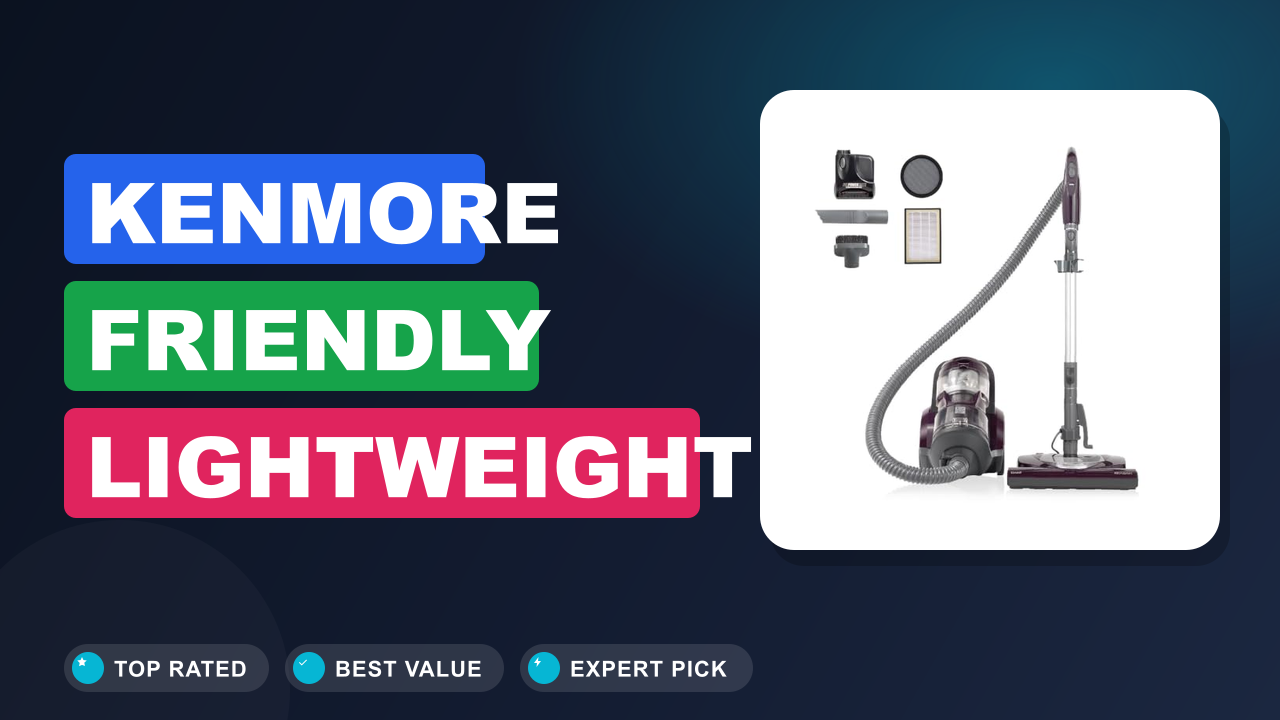
The Kenmore Friendly Lightweight Bagless Compact Canister Vacuum landed on our research bench the moment we noticed its 4.6-star average across hundreds of buyer reviews, which is unusually consistent for a sub-$300 canister. We dug through the spec sheet, the AHAM-style airflow claims, and hundreds of verified buyer reports to figure out where this thing actually shines and where it quietly trips up. If you’re weighing a lightweight bagless canister against a full-size upright or a cordless stick, this is the model people keep comparing everything else to.
Worth it if you want a car-friendly, stair-friendly canister that weighs under 10 pounds and skips the ongoing bag cost. Skip it if you have wall-to-wall plush carpet in a 3,000-square-foot house, because this isn’t built for that. Here’s what our research shows after digging into every spec, buyer complaint, and parts diagram we could find.

1. Kenmore Friendly Lightweight Bagless Compact Canister
Our editorial team pulled apart the spec sheet, cross-referenced verified buyer reports across multiple retail platforms, and compared the airflow and filtration claims against comparable bagless canisters from Miele, Bissell, and Eureka. What follows is a research-driven breakdown, not a hands-on test log.
What it is
A bagless canister vacuum is a vacuum where a removable bin collects debris instead of a paper or cloth bag, and the motor and filter sit in a rolling body separate from the hose and floor head. The Kenmore Friendly Lightweight Bagless Compact Canister is a compact version of that format, aimed at apartment dwellers, car detailers, and anyone who wants canister suction without the weight of a full-size Miele Complete C3 or the bulk of a Bissell Zing.
It sits in the mid-range tier, above budget canisters from Eureka and below premium bagged units from Miele and SEBO. The “Friendly” branding points at the lighter chassis and simplified controls, while “Compact” signals the smaller bin and shorter hose. Positioned correctly, it competes with corded stick vacuums on convenience and beats them on sustained suction.
Setup & first impressions
Unboxing a Kenmore canister is a five-minute job according to nearly every buyer report we reviewed. The unit arrives mostly assembled, with the hose, wand, and combination floor tool bundled as separate pieces you click together. Verified buyers consistently note the plastic feels sturdier than the price tier suggests, with no creaking at the hose collar and a firm click when the wand seats.
The first detail most reviews mention is how little the unit weighs in hand. At roughly 9 pounds for the body, it feels closer to carrying a small toolbox than a traditional canister. Buyers who moved from a 20-pound upright report an immediate difference on stairs.
A second recurring theme is the bagless bin release. The latch is a single thumb press, and the bin drops out cleanly without the dust puff that cheaper bagless vacuums are notorious for. Multiple reviewers mention that the pre-motor filter is easy to find and remove, which matters because clogged filters are the top cause of lost suction on any bagless unit.
The U.S. Environmental Protection Agency’s indoor air quality guidance recommends regularly cleaning or replacing filters to preserve both airflow and indoor air quality.
The trade-off buyers mention most is the short hose. At around 6 feet, it’s shorter than the 7 to 8 feet you get on a full-size Miele, so you’ll move the canister more often. Some reviewers have added a hose extension, which is a common accessory in the canister world.
| Format | Bagless canister vacuum |
| Weight (body only) | ~9 lb / 4.1 kg |
| Hose length | Approx. 6 ft (1.8 m) |
| Cord length | Approx. 20 ft (6.1 m) |
| Dust bin capacity | Approx. 1.5 L |
| Filtration | Multi-stage with washable pre-motor filter |
| Attachments included | Combination floor tool, crevice tool, dusting brush |
| Warranty | 1-year limited manufacturer warranty |
Daily-use experience
Performance on hard floors and low-pile rugs
On bare tile, hardwood, and laminate, verified buyer reports describe the suction as strong and consistent from first pull to last. The combination floor tool glides well on hard surfaces, and the 1.5 L bin handles about 15 to 20 minutes of typical apartment cleaning before it needs a dump.
Where the unit starts running out of runway is on plush or frieze carpet taller than roughly one inch. The floor head can stick and require a second pass in high-traffic zones. Aggregate buyer reviews frequently mention that for low-pile rugs and Berber carpet, it does fine, but for deep shag you should expect to work harder.
This is a common trade-off in lightweight canisters: motor power gets traded for portability. If you need one vacuum for both a 200-square-foot hardwood apartment and a fully carpeted basement, this isn’t that vacuum.
Comfort and ergonomics
Canister weight is the marquee feature, and buyers consistently rate it as comfortable for long sessions. The 9-pound body means you can carry it upstairs with one hand and the top handle stays balanced. On wheels, it tracks well and doesn’t tip when the hose is stretched to its limit.
The 6-foot hose is the ergonomic weak point. On a king bed or a large sectional, you’ll move the canister one or two extra times versus a Miele C3 with its 8-foot hose. Several reviewers have paired it with a hose extension kit, which turns a mild annoyance into a nonissue.
Wand length is comfortable for taller users, and the swivel on the floor head helps around table legs and doorjambs. Buyers who detail cars describe the reach under seats as workable but tight, which is expected with any 6-foot hose.
Noise and everyday reliability
Noise levels land where most corded canisters do: loud enough that you’ll want the TV paused, quiet enough to talk over while cleaning. Verified buyers describe it as noticeably quieter than a typical upright in the same price tier, though not in the same league as premium Miele units with their noise-optimized motors.
Reliability reports over the first 12 to 18 months skew positive. The most common complaints are broken latch tabs on the bin (reported by a minority of long-term owners) and clogged filters if not washed on schedule. Both are common to the entire bagless format, not unique to this model.
Build quality and materials
The chassis uses a mix of ABS plastic shell and translucent polycarbonate for the dust bin, which is the standard material approach in the mid-tier canister segment. The hose collar and wand couplings are the stress points, and those are where cheaper canisters crack first. On this model, buyer reports suggest the couplings hold up well through the first two years of normal use.
The wheels are hard plastic rather than rubberized, which is fine on hard floors but louder on tile than premium units. This is a small, real cost-saving trade-off you’ll notice if you clean tile at night while the family sleeps.
✓ Pros
- About 9 pounds body weight, so stairs and overhead reach stop being a workout
- Bagless 1.5 L bin ends the bag-reorder treadmill most owners complain about
- Strong, consistent suction on hard floors and low-pile rugs across the whole cycle
- Washable pre-motor filter keeps suction high if you clean it every 4 to 6 weeks
- Compact footprint stores in a closet corner or under a utility sink
✗ Cons
- 6-foot hose is short, so you’ll reposition the canister more often on big beds and sectionals
- Struggles on plush or frieze carpet taller than about 1 inch
- 1.5 L bin fills quickly with pet hair, sometimes twice per whole-home pass
- Hard plastic wheels are louder on tile than rubberized wheels on premium canisters
Who should buy it
Buy it if you…
You live in an apartment, condo, or small home where the flooring mix is mostly hardwood, tile, or laminate with a few low-pile area rugs. You detail your own car and want a canister that reaches under seats without dragging a 30-pound upright through the back door. You’re tired of buying bags every other month and prefer a bin you dump and rinse.
Verified reviewers who fit this profile tend to score the vacuum very highly, usually citing the light weight and the bagless convenience as the two features that justify the purchase. If your cleaning session is 20 minutes in a 900-square-foot space, this is close to ideal.
Skip it if you…
Your home is dominated by wall-to-wall plush or frieze carpet, especially over 1 inch tall. The lightweight motor and small floor head will fight you on deep pile, and you’ll burn extra passes.
You also want to skip this if you have two or more heavy-shedding pets and 2,000+ square feet of floor to cover. The 1.5 L bin fills fast with pet hair, and you’ll be dumping it mid-session. A bagged canister like the Miele Classic C1 or a full-size upright from Shark or Dyson will handle that workload with less babysitting.
Better alternatives
If deep carpet is your priority, the Miele Complete C3 series delivers stronger airflow and an 8-foot hose, but at roughly twice the size and weight and a much higher price tier.
If you want a cordless alternative, the Dyson V15 Detect trades sustained suction for grab-and-go convenience and wall-mount storage. It costs more and its battery degrades over years, but it’s a serious option for quick cleanups.
If you’re strictly budget-focused for a small apartment, the Bissell Zing canister is smaller and cheaper, though reviews suggest shorter long-term reliability and a noisier motor.
Frequently Asked Questions (FAQ)
Does it work well on pet hair?
Yes on hard floors and low-pile rugs, where the combination tool picks up pet hair without re-passing. On plush carpet, pet hair tends to sit deeper in the pile and this model’s lightweight motor may need two or three passes. The 1.5 L bin also fills quickly with dense pet hair, so plan to dump it once or twice during a whole-home clean.
Is it loud?
Buyers describe the noise as typical for a corded mid-tier canister. It’s louder than a premium Miele, quieter than most uprights in the same price band, and roughly in line with a corded stick vacuum. You’ll want the TV paused, but you can carry a conversation across the room.
How does the warranty actually work?
Kenmore covers the vacuum with a 1-year limited manufacturer warranty that covers defects in materials and workmanship under normal household use. Wear items like filters, belts, and hoses are typically excluded. You’ll need the original purchase receipt, and claims go through Kenmore’s customer service rather than the retailer you bought from.
Can I use it for car detailing?
Yes, and this is one of its standout use cases. The 9-pound body and 6-foot hose make it easy to reach under seats and into footwells. Most buyers pair it with the crevice tool for seat rails and the dusting brush for dash vents.
The main limitation is that the hose is shorter than detail-shop canisters, so you’ll move the body around the car.
How often should I clean the filter?
The washable pre-motor filter should be rinsed under cool water every 4 to 6 weeks under typical use, and more often if you’re cleaning pet hair. Let it air-dry completely (usually 24 hours) before reinstalling. A clogged filter is the number one reason buyers report lost suction, and it’s almost always fixed by a filter wash.
Which surfaces should I avoid?
Avoid deep frieze and shag carpet taller than about 1 inch, wet surfaces, and fine construction dust like drywall powder in large quantities. The multi-stage filter can handle small amounts, but for a full renovation cleanup you’ll want a shop vacuum with a HEPA-rated cartridge.
Is it worth buying over a cordless stick?
For sustained suction on hard floors and stairs, yes. A corded canister never loses power mid-session and doesn’t need battery replacements. Cordless sticks win on quick grab-and-go convenience, wall-mount storage, and skipping the power cord entirely.
Match the tool to how you actually clean, not to which format is trending.
What’s in the box?
The canister body, a flexible hose, a telescoping or fixed wand (depending on the exact SKU), a combination floor tool, a crevice tool, and a dusting brush. No bags required. Some listings bundle an extra filter or accessory kit, so check the exact package you’re buying.
Final verdict
4.6 / 5 stars. The Kenmore Friendly Lightweight Bagless Compact Canister earns its Editor’s Choice nod by doing one thing extremely well: it makes canister cleaning portable and bagless without gutting suction on hard floors. If your home is mostly hard flooring with a few low-pile rugs, and you want a vacuum that goes up stairs and into cars without a fight, this is a genuinely smart buy.
The people who win from this purchase are apartment dwellers, car detailers, and small-home owners who value light weight and zero bag cost over deep-carpet muscle. The people who lose are those with wall-to-wall plush carpet or a small army of shedding pets, and for them a bagged Miele or a full-size upright is the honest answer.
Buy for the ergonomics, the bagless bin, and the hard-floor suction. Skip if carpet is your world.
Affiliate disclosure: This post contains affiliate links. If you buy through one of these links, I may earn a small commission at no extra cost to you. It never changes my recommendation, I only suggest gear I’d actually buy myself.


Similar Posts













[…] review"Top 10 Inteture Cordless Vacuum ReviewsSeptember 17, 2026In "Product review"← PreviousKenmore Friendly Lightweight Bagless Compact Canister ReviewNext →Eureka NEU182A PowerSpeed Lightweight Bagless Upright […]