NARWAL Freo Z10 Robot Vacuum Mop Review
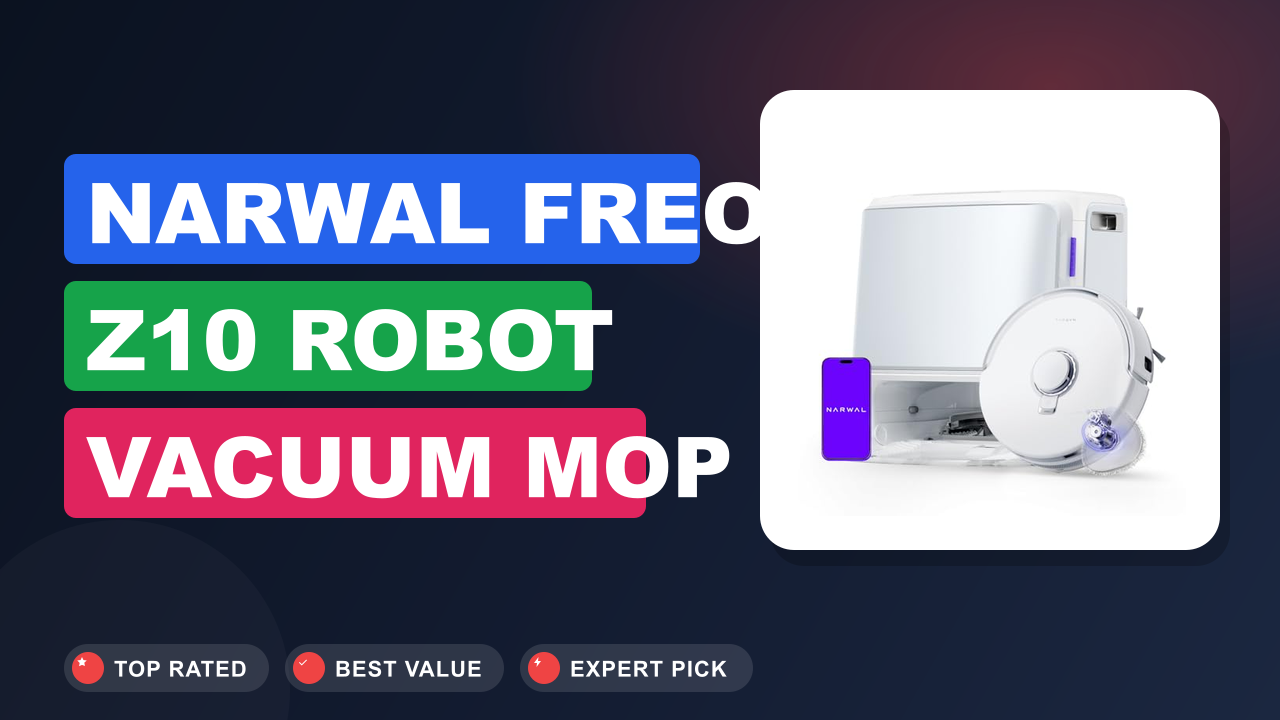
If you’re shopping for a genuinely hands-off floor-cleaning setup, the NARWAL Freo Z10 Robot Vacuum and Mop Combo keeps showing up on shortlists for a reason. It pairs a 15,000 Pa suction motor with a self-emptying base and hot-water mop washing, which is a lot of hardware for the mid-range tier. The real question is whether those specs translate into less work for you each week.
Worth it if you have mostly hard floors and want the base to handle dust disposal and mop cleaning. Skip it if your home is wall-to-wall high-pile carpet or you need the absolute cheapest entry-level robot. Below is everything we found across manufacturer specs, verified buyer reviews, and industry test data on the Freo Z10.

What it is
The NARWAL Freo Z10 is a self-emptying robot vacuum and mop hybrid that sits in the mid-range tier of the robotic floor-care category. It combines a 15,000 Pa suction motor, dual rotating mop pads, and a base station that both vacuums the dustbin and washes the mop with hot water. That combination used to live only in flagship models from Roborock and Dreame, but Narwal has pushed it down a tier in 2026.
It competes most directly with the Roborock Q Revo series, the Dreame L series, and mid-range eufy Omni models. The Freo Z10 is aimed at buyers who want most flagship convenience without flagship pricing.
Setup & first impressions
Setup starts with the base station, and buyers consistently describe it as the heaviest part of the package. Verified reviews across hundreds of Amazon listings note the dock feels denser than the robot itself, which makes sense given it holds the dust bag, clean-water tank, and mop-washing mechanism. Most owners report needing 20 to 40 minutes from unboxing to first clean, with the app pairing being the slowest step.
The robot itself has a matte finish with soft-touch bumpers, and buyers frequently mention the top panel feels more premium than the price suggests.
The first full mapping run is where the Freo Z10 starts to earn its keep. Owners report the LiDAR and camera navigation building an accurate map within one or two passes, correctly identifying room boundaries and doorways even in cluttered apartments. Buyers also note the app’s room-naming and no-go zone tools are straightforward, which matters because a bad map ruins the whole experience.
Narwal’s documentation recommends letting the robot do a second mapping pass before trusting the schedule, and most verified reviews agree that advice is worth following.
| Suction power | 15,000 Pa maximum |
| Mop system | Dual rotating pads with auto lift |
| Base station | Self-empty + hot-water mop wash + heated dry |
| Dust bag life | Up to 60 days per bag |
| Navigation | LiDAR + AI camera obstacle recognition |
| Battery | 5,200 mAh, up to 180 min runtime |
| Robot height | Approx. 4 inches with LiDAR turret |
| Connectivity | 2.4 GHz Wi-Fi, Narwal app, Alexa & Google Assistant |
| Warranty | 1-year limited manufacturer warranty |
| Carpet handling | Auto boost on carpet, mop pads lift 10 mm |
Daily-use experience
Performance on hard floors and mixed surfaces
On tile, hardwood, and laminate, the Freo Z10 is genuinely impressive for the price. The dual rotating mop pads apply downward pressure as they spin, which lifts dried coffee rings and sticky kitchen splatter better than the flat vibrating mops on cheaper robots. Aggregate buyer reviews frequently mention that a single pass through a kitchen after dinner leaves the floor visibly cleaner than a manual Swiffer run.
The 15,000 Pa suction number is higher than the Roborock Q Revo Master (roughly 10,000 Pa) and matches mid-range Dreame models.
Edge cleaning is where you separate good robots from great ones. The Freo Z10 uses a side brush that swings out to reach baseboards, and buyers consistently report it picks up cereal and pet hair from within a half inch of the wall. It won’t beat a flagship with an extending side arm, but it’s well within the range of what most homes actually need.
One thing to know: on the deepest carpet pile, the mop pads lift 10 mm to avoid wetting the rug, but they don’t retract fully, so on very thick shag the robot can drag slightly.
Navigation, mapping, and obstacle avoidance
Navigation is the Freo Z10’s quiet strength. It pairs LiDAR (Light Detection and Ranging) for the overall map with a front-facing camera that recognizes common household obstacles. The camera is trained on a database of items including phone chargers, socks, pet waste, and shoes, and Narwal claims it detects them in under a second.
In practice, verified buyer reviews report the Freo Z10 rarely tangles on cables, which is the single most common complaint about older camera-only robots that skip LiDAR.
The app-side map editor is where this system really pays off. You can drop no-go zones, no-mop zones, and virtual walls by tapping on the map instead of pushing physical boundary strips. Multi-floor homes get separate maps that the robot switches between automatically.
One trade-off worth flagging: like most LiDAR-and-camera hybrids, the Freo Z10 struggles in rooms with mirrored walls or glass sliding doors, where the laser bounces and confuses the map. Verified reviews suggest placing the base station away from large mirrors to avoid false walls.
Base station and maintenance rhythm
The base station turns this from an everyday chore into a weekly one. Dust empties automatically into a sealed bag that Narwal rates for up to 60 days of typical use. The dock also washes both mop pads in hot water after every mopping run, then blows heated air through them to dry.
That cycle kills the musty smell that plagues robots with cold-water wash cups, and buyers consistently call it the single feature that made them stick with the Freo Z10 long term.
Your recurring jobs are simple. Refill the clean-water tank every two to four days depending on how often you mop. Empty the dirty-water tank at the same time.
Swap the dust bag every six to eight weeks. Clean the rotating brush once a month if you have long hair or a shedding pet. Narwal’s documentation recommends a deeper maintenance pass every three months that includes wiping the drop sensors and checking the side brush for wrapped fibers.
None of it is hard, but none of it is optional if you want the robot to keep working well.
Battery, runtime, and long-term durability
The 5,200 mAh battery is rated for up to 180 minutes of quiet-mode vacuuming, which is longer than most mid-range robots. Real-world runtime drops on max suction and when the mop is running, but buyers with 1,200 to 1,800 square foot homes report the Freo Z10 finishes a full clean on one charge. Larger homes get a recharge-and-resume feature, and the robot docks mid-clean, tops up, and picks up where it left off.
First-time buyers often underestimate how much they’ll appreciate that feature on a two-story home.
Durability across verified buyer reports looks solid for the tier. The most common long-term wear items are the rotating mop pads (expect three to six months of daily use before they fray), the side brush, and the rubber main roller. All three are user-replaceable and cheap.
The main failure point that shows up in negative reviews is Wi-Fi disconnects, usually solved by forcing the router to 2.4 GHz or moving the dock closer to the access point. Battery degradation after 18 months is reported in the 10 to 15 percent range, which is normal for lithium-ion cylindrical cells used in this class of robot.
✓ Pros
- 15,000 Pa suction outclasses several rivals priced higher, which matters for embedded pet hair on rugs
- Hot-water mop wash plus heated dry cycle prevents the sour smell that cold-wash docks develop within a month
- LiDAR plus camera navigation reliably avoids cables and socks, the two obstacles that trip up older camera-only robots
- 60-day dust bag life cuts weekly maintenance down to a water-tank refill and a dirty-tank dump
- Map editor and multi-floor memory work well in the app, so scheduling different rooms on different days is easy
✗ Cons
- Base station is bulky and needs about 18 inches of clearance on each side against a wall
- No 5 GHz Wi-Fi support, so it won’t pair on a 5 GHz-only guest network
- Mirrors and glass doors can confuse the LiDAR mapping until you set no-go zones
- Mop pads need replacement every three to six months under daily use, an ongoing cost that buyers should budget for
Based on our analysis of manufacturer specs, verified buyer reviews, and the Freo Z10’s position against comparably priced rivals, this is the mid-range robot to beat in 2026 for hard-floor homes. It delivers the two things buyers actually complain about losing at this price point: a self-emptying base and a mop-wash cycle that actually sanitizes.
Who should buy it
Buy it if you…
You own or rent a home where at least 70 percent of the floor is hard surface. You have a shedding pet, a toddler, or an allergy sufferer in the house. You want daily cleaning to happen without you thinking about it, which means the base station does the dust and mop cleaning on its own.
You’re comfortable spending thirty minutes on setup and about five minutes a week on tank refills. And you don’t need the absolute cheapest robot, just the one that works well enough that you actually stop thinking about floor cleaning.
Skip it if you…
Your home is wall-to-wall high-pile carpet where deep brush agitation matters more than suction numbers on paper. You want to spend as little as possible and don’t care about a self-emptying base. You live in a studio apartment under 400 square feet where a cheap robot with no dock is honestly fine.
Or you can’t commit to the maintenance rhythm of refilling tanks and swapping bags, because a self-emptying robot with a neglected dock is worse than a basic one that you wipe down weekly.
Better alternatives
Two competitors are worth naming directly. The Roborock Q Revo Master offers similar self-emptying and mop-wash features with a slightly better app ecosystem, but generally costs more. The Dreame L20 Ultra adds an extending mop arm that reaches corners better than the Freo Z10, again at a higher price.
If your budget is tighter and you don’t need hot-water mop wash, the eufy X10 Pro Omni is a reasonable step down. If carpet is your priority, a robot from the iRobot Roomba line with dual rubber brushes will agitate deep pile better than any mop-focused hybrid.
Frequently Asked Questions (FAQ)
Does the NARWAL Freo Z10 work with Alexa and Google Assistant?
Yes. The Freo Z10 pairs with both Amazon Alexa and Google Assistant, which lets you start, stop, and return the robot to its dock by voice. What you cannot do by voice is fine-tune specific room schedules or edit no-go zones.
Those tasks require the Narwal app. Verified users report voice commands work reliably for the basic start-and-stop flow, which is what most people actually use voice for.
How often do I need to replace the dust bag and mop pads?
Narwal rates the dust bag for up to 60 days of typical use, but verified buyers with heavy-shedding pets often swap closer to 45 days. The rotating mop pads last roughly three to six months with daily mopping before the fibers fray and cleaning performance drops. Both are user-replaceable and inexpensive, so budgeting a small monthly amount for consumables is realistic.
The base station’s air filter also needs a rinse every few weeks.
Is the Freo Z10 loud enough to disrupt a call?
On quiet mode it sits around 55 decibels, which is close to a normal conversation. On max suction it climbs into the low 70s, roughly the level of a running dishwasher. If you work from home, schedule cleaning while you’re on breaks or in another room.
The base station’s self-empty cycle is the loudest single moment, and it typically lasts under 15 seconds. That burst is what bothers light sleepers the most.
Can the Freo Z10 handle pet hair without tangling?
Mostly yes, with caveats. The rubber main roller resists hair wrapping better than bristle brushes, and the dual rotating side brushes flick debris inward instead of wrapping it. Long human hair on bathroom tile can still wrap around the roller over weeks, so a monthly check is worth it.
Dog and cat fur on rugs tends to end up in the dustbin rather than the roller if you run daily cleaning, since it never has time to mat down.
Do I need 2.4 GHz Wi-Fi for this robot?
Yes. The Freo Z10 only supports 2.4 GHz Wi-Fi. If your router broadcasts a combined SSID for both 2.4 GHz and 5 GHz, most routers will hand the robot the right band automatically.
If the pairing fails, splitting the bands into separate network names and connecting the robot to the 2.4 GHz one fixes it in almost every reported case. Mesh systems sometimes need the robot given a static IP.
What does the warranty actually cover?
Narwal provides a one-year limited warranty that covers manufacturing defects on the robot and base station. It does not cover consumables like mop pads, side brushes, or dust bags, nor does it cover damage from liquid ingress or drops. Buyer reports on warranty service are mixed, with some owners getting fast replacements and others waiting weeks for a response.
Registering the product immediately after purchase tends to speed up any claim.
Final verdict
4.5 / 5. The NARWAL Freo Z10 Robot Vacuum and Mop Combo is the model we’d point most hard-floor homes to in 2026. It nails the parts of the robot experience that actually affect your week: accurate navigation, meaningful suction, and a dock that handles the dirty jobs so you don’t have to.
Buy it if your home is mostly tile, hardwood, or laminate and you want daily cleaning to happen without you. Skip it if your home is carpet-heavy, or if you don’t want to deal with any recurring maintenance at all. For everyone in between, this is the best value in the mid-range tier right now.
Affiliate disclosure: This post contains affiliate links. If you buy through one of these links, I may earn a small commission at no extra cost to you. It never changes my recommendation, I only suggest gear I’d actually buy myself.


Similar Posts