How Often To Replace Air purifier Filter
Let’s cut through the confusion. You bought an air purifier to breathe cleaner air, but if you’re not changing the filter on time, you’re basically running a fancy fan. The question “how often to replace air purifier filter” doesn’t have a single magic number, but it does have clear rules.
I’ve tested dozens of units and talked to HVAC experts. Here’s what actually matters.
The Short Answer – General Guidelines
Most manufacturers recommend replacing the HEPA filter every 6 to 12 months. Carbon pre-filters go faster, every 3 to 6 months. But that’s a starting point, not a rule.
Your real replacement schedule depends on how dirty your air is, how long you run the unit, and what kind of filter you have.
If you run your purifier 24/7 in a house with pets and open windows, you’ll be on the short end of that range. Use it only at night in a clean, closed-off bedroom? You might stretch past 12 months.
The key is knowing when the filter is actually done, not just guessing by the calendar.
Why Replacement Frequency Varies
Filter Type
Not all filters are created equal. A washable pre-filter can last years if you clean it monthly. A true HEPA filter is a dense maze of fibers that traps particles physically, once it’s full, you can’t clean it (more on that later).
Activated carbon filters absorb gases and odors chemically, which means they saturate over time and stop working even if they look clean.
Usage Hours and Environment
A purifier running 12 hours a day in a smoky kitchen sees way more load than one used two hours a night in a spare bedroom. The EPA’s guide to indoor air quality points out that indoor particle levels can spike during cooking, cleaning, or even opening windows. More particles hitting the filter means it fills up faster.
Simple math.
Air Quality in Your Area
Live near a highway, in a wildfire-prone zone, or in a dusty agricultural area? Your filter works harder. I’ve seen HEPA filters clog in three months during California fire season.
Someone in a low-pollution rural area might get 18 months out of the same filter. Your local air quality index (AQI) is a better predictor than any sticker on the box.
Specific Timelines by Filter Type
Let’s break it down by the actual component you’re dealing with.
Pre-Filters (Washable vs Disposable)
Pre-filters catch the big stuff, dust bunnies, pet hair, lint. They’re the first line of defense.
- Washable pre-filters: Vacuum or rinse every 2, 4 weeks. Replace only if damaged. With proper care, they can last the life of the purifier.
- Disposable pre-filters: Replace every 3 months. Some brands call them “carbon pre-filters”, if they’ve got carbon, replace at 3 months even if they look clean because the carbon stops working.
HEPA Filters
True HEPA filters (H13 or H14 rating) trap 99.97% of particles down to 0.3 microns. They are not washable. Most manufacturers say 6, 12 months.
I recommend erring on the side of 8 months if you run the unit daily. In my home with two cats, I swap my main unit’s HEPA every 9 months like clockwork.
But here’s the catch: if you see visible darkening across the entire surface, replace it early. If the filter still looks white but airflow dropped noticeably, it’s time.
Activated Carbon Filters
Carbon filters remove VOCs, smoke, cooking odors, and chemical fumes. They don’t get “clogged” in the same way HEPA does, they saturate. Once the carbon is full, it stops adsorbing.
You might not notice until the smell starts coming back.
Timeline: 3, 6 months for typical use. If you’re sensitive to odors or live in a polluted area, change at 3 months. Some high-quality carbon filters with lots of media can last 6, 9 months, but most budget ones are toast by month 4.
Combined / All-in-One Filters
Many modern purifiers use a single cartridge that combines a pre-filter layer, HEPA media, and a carbon sheet. Convenient, but the replacement interval is driven by the weakest link, usually the carbon. These combos typically need replacement every 6 months.
Don’t try to stretch them to 12 months; the carbon dies long before the HEPA does.
Signs Your Filter Needs Replacing (Don’t Rely Only on the Calendar)
Manufacturer recommendations are a baseline. Your actual filter life might be shorter or longer. Here are the real-world signs that it’s time.
Reduced Airflow
Hold your hand up to the outlet vent. If the air feels noticeably weaker than when the unit was new, the filter is clogged. The motor works harder, the unit gets noisier, and your room stays dirtier.
This is the most reliable physical symptom.
Increased Noise
A purifier that used to hum quietly now sounds like it’s struggling. That’s because the fan has to spin faster to push air through a blocked filter. More noise = less efficiency.
Smells or Odors
If you start smelling cooking or outdoor pollution indoors again, the carbon layer is spent. For pure HEPA filters (no carbon), you might notice a musty or dusty odor, that’s trapped particles breaking down or off-gassing. Either way, swap it.
Visible Dust or Darkening
Open the front grille and inspect the filter. If the surface is covered in a thick gray/black layer, especially if it’s uniform across the whole face, it’s full. Some people try to vacuum it, but that only removes surface debris from the top layer, not the deep-seated particles.
HEPA fibers trap stuff throughout the matrix.
Smart Indicator Alerts
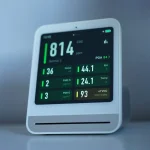
Many modern purifiers have a filter replacement light or percentage meter. Trust them, but with a grain of salt. Some are just timers that count down regardless of actual load.
Others use a pressure sensor. Check your manual to know which type you have. A timer-based indicator might tell you to replace at 6 months even if the filter is still clean, while a sensor-based one is more accurate.
Real-World Factors That Speed Up Replacement
Your environment dictates the real schedule. Here’s what shortens filter life significantly.
Pets and Shedding
I’m speaking from experience. Dogs and cats generate dander, fur, and tracked-in dirt. A pre-filter will fill up in days if you don’t vacuum it.
HEPA filters in pet households often need replacement every 4, 6 months. If you have multiple pets, budget for twice-a-year swaps.
Smoking or Cooking
Tobacco smoke and heavy cooking (especially frying or grilling indoors) load filters with fine particulate and sticky residue. That carbon layer saturates fast. For smokers, plan to replace every 3 months.
For heavy cooks, every 4, 5 months.
Construction or Renovation
If you’re remodeling, sanding, sawing, drywall, turn the purifier off or move it out of the room. Those fine construction dusts will ruin a HEPA filter in weeks. If you must run it, expect to replace the filter immediately after the project ends.
High Pollution or Wildfire Season
During wildfire smoke events, outdoor PM2.5 levels can be 10, 50 times normal. A purifier running 24/7 in those conditions will load its filter fast. I’ve seen HEPA filters go from clean to dark grey in one week of bad smoke.
Check your local AQI and plan to replace the filter post-season.
Can You Clean a HEPA Filter? (Spoiler: Usually Not)
This is the most common myth I hear. People want to vacuum a HEPA filter or even wash it to save money. Don’t.
Washing a HEPA filter destroys the fiber structure. The water clogs the pores further, and the drying process can shrink or warp the media. Once it’s wet, it’s trash.
Vacuuming can remove loose surface debris from the pre-filter side, but it doesn’t restore lost efficiency. The trapped particles deep inside the matrix stay put.
Some brands sell “permanent” or “washable” HEPA filters, those are not true HEPA. They’re electrostatic media that rely on static charge. True HEPA is a mechanical barrier.
If your manual says “permanent” or “clean with vacuum,” you can try it. But for standard HEPA, replace, don’t clean.
Consequences of Ignoring Filter Replacements
Let’s be blunt: running a purifier with a dirty filter is worse than running nothing at all. Here’s why.
Reduced Efficiency
A clogged filter can’t capture new particles effectively. The air just bypasses the media through gaps or moves too slowly to catch fine particles. Your CADR (clean air delivery rate) drops by 50% or more.
You’re paying electricity to barely clean the air.
Strain on the Motor
The fan has to work harder to push air through a blocked filter. That increases energy consumption and heat buildup. Over time, it can burn out the motor.
I’ve seen units fail permanently because someone ignored the filter for two years. A replacement filter costs $30, $80. A new purifier costs $200, $800.
Poor Air Quality (Releasing Trapped Particles)
Once a HEPA filter gets overloaded, it can actually release captured particles back into the room. The fibers get so packed that air pressure pushes some particles loose. The “clean” air coming out is dirtier than it would be without any filter.
This is the hidden danger, you think you’re breathing clean air, but you’re not.
How to Prolong Filter Life Without Sacrificing Performance
You don’t have to replace filters every two months. A few smart habits can extend the lifespan while keeping air quality high.
Vacuum the Pre-Filter Regularly
If your unit has a washable or vacuumable pre-filter (most do), clean it every two weeks. That alone can double the life of the main HEPA. I vacuum mine with a brush attachment on my regular vacuum cleaner.
Takes 30 seconds.
Run the Unit on Lower Fan Speed When Possible
High speed pulls more air and loads the filter faster. Run the purifier on low or medium overnight and during times when air quality is good. Use turbo only when needed, after cooking, during cleaning, or when outdoor smoke is bad.
Keep Windows and Doors Closed
Every open window lets in outdoor dust and pollen. If you run the purifier in a room with an open window, you’re basically trying to filter the whole outside. That’s wasteful.
Keep the room sealed while the purifier is on for maximum efficiency and longer filter life.
Maintain a Clean Home
Vacuum floors, dust surfaces, and wash bedding regularly. Less dust in the room means less dust hitting the filter. A clean home is the cheapest way to extend filter life.
Cost vs Benefit – Is It Worth Replacing on Schedule?
I’ve heard people say “the filter costs almost as much as a new purifier.” That’s sometimes true for cheap units where a replacement filter is $40 and the whole machine was $80. But here’s the thing: a new machine costs the same as three or four filter replacements. And if you don’t replace the filter, the machine stops working anyway.
My advice: treat the filter as a consumable, like printer ink or a vacuum bag. Budget for it. If the replacement cost bothers you, buy a purifier that uses cheaper generic filters or has washable pre-filters.
But never skip a replacement to save $20, you’re paying for bad air.
Final Checklist – Quick Reference for Replacement Intervals
| Filter Type | Typical Replacement Interval | Notes |
|---|---|---|
| Washable pre-filter | Clean every 2–4 weeks, replace if torn | Usually lasts as long as the unit |
| Disposable pre-filter (carbon) | Every 3 months | Carbon stops working before it looks dirty |
| True HEPA filter | Every 6–12 months | 8 months is a safe average for most homes |
| Activated carbon filter (bulk) | Every 3–6 months | Replace when odors return |
| Combined HEPA + carbon | Every 6 months | Weak link is carbon; don’t push to 12 months |
| Smart indicator | Follow unless it’s a timer-only system | Sensor-based ones are more reliable |
Wrapping It Up
How often to replace an air purifier filter depends on what you’re filtering, how much you use it, and the air you’re cleaning. The general rule, 6 to 12 months for HEPA, 3 to 6 months for carbon, works for most people. But watch for reduced airflow, increased noise, return of smells, and visible dirt.
Those are your real cues.
Don’t guess. Don’t gamble with your air. Set a reminder on your phone, check the filter every couple of months, and replace it when the signs are there.
Your lungs will thank you, and your purifier will last longer. That’s the only answer that matters.


Similar Posts