How Dehumidifier Works
Let’s be honest: you bought a dehumidifier, or you’re thinking about buying one, because your basement smells like a damp sponge and your windows are constantly dripping with condensation. But have you ever actually stopped to think about the magic happening inside that box? It feels like sorcery, a machine that just sucks water out of thin air.
It isn’t sorcery. It’s physics. Specifically, it’s the same refrigeration cycle that keeps your food cold, just reversed in a clever way.
By the end of this article, you’ll understand exactly how a dehumidifier works, what happens to the water it collects, and why that simple process makes your home healthier, more comfortable, and less likely to grow mold.
Image source: Pexels / Nicolas Foster (Pexels License)
What Is a Dehumidifier, Really?
Before we dive into the guts of the machine, let’s define what we’re dealing with.
A dehumidifier is essentially a portable air-conditioning unit that doesn’t cool the room down. Instead, it focuses all its energy on one task: pulling moisture out of the air. It works by creating a miniature climate zone inside the unit where the air is so cold that it physically cannot hold onto its water vapor.
Here’s a quick fact that helps everything click: Warm air holds more water vapor than cold air. That’s why a hot, humid summer day feels like walking through soup, while a chilly autumn afternoon feels crisp and dry. A dehumidifier exploits this exact principle.
Air gets sucked in, it hits a freezing-cold coil, the water condenses out of it (just like a cold drink sweating on a hot day), and then the dry air gets reheated and pushed back out into your room.
Simple in theory. Let’s look at the parts that make it happen.
The Core Components: A Tour Inside the Machine
Every standard compressor-based dehumidifier (which is what 95% of homes use) shares the same basic anatomy. You don’t need to memorize these, but understanding them makes the whole process clear.
- The Compressor: This is the heart of the machine. It acts like a pump, pressurizing refrigerant gas and pushing it through the system.
- The Condenser Coil: This is the hot side. The refrigerant passes through here as a hot gas, and it looks like a radiator.
- The Expansion Valve: This tiny device causes a massive pressure drop, which rapidly cools the refrigerant.
- The Evaporator Coil: This is the cold side. It’s the freezing-cold surface that actually pulls water from the air. It usually sits right next to the condenser coil.
- The Fan: This pulls humid room air in and forces the dry air back out.
- The Collection Tray/Bucket: This sits under the evaporator coil and catches the dripping condensation.
- The Humidistat: This is the thermostat for humidity. It tells the unit when to turn on and off based on the relative humidity in the room.
These parts work in a continuous loop. The system never stops cycling the refrigerant, and the fan never stops moving air across the coils.
How a Dehumidifier Works: The Refrigeration Cycle, Step by Step
If you take one thing away from this article, let it be this breakdown. It’s the answer to the question “How a dehumidifier works” in a nutshell.
Step 1: The Fan Pulls in Humid Air
The process starts at the fan. It sucks in that heavy, muggy air from your basement or crawl space. This air is full of invisible water vapor.
Step 2: The Air Hits the Freezing Evaporator Coil
This is where the real action happens. The fan pushes the air across the evaporator coil. Thanks to the expansion valve, this coil is chilled to around 40°F (4°C) or lower.
That’s well below the dew point of most indoor air.
Step 3: Condensation Forms (The Shedding Phase)
Since the coil is so cold, the air rapidly loses its ability to hold water. The water vapor in the air changes state, it condenses into liquid droplets on the coil’s surface. This is exactly what happens when you hold a cold glass of lemonade outside on a summer afternoon.
The glass “sweats” because water molecules from the air are cooling down and physically sticking to the surface.
Step 4: Water Drops into the Tray
The droplets of water on the evaporator coil grow bigger and bigger until gravity wins. They drip down the coil and into the collection tray or bucket below. This is the water you’re always emptying.
Step 5: The Air Passes Over the Heat Exchanger
Now we have a problem. The air is dry, but it’s also cold. If the unit blew that cold air into your room, you’d feel a draft.
So, the air is passed over the condenser coil (the hot side) and the compressor. This reheats the air back to almost room temperature, sometimes even warmer.
Step 6: The Dry, Warm Air Exits
The newly dried and reheated air is pushed back out of the top vent. It mixes with the room air, lowering the overall relative humidity.
That’s the entire secret. Refrigerate, condense, collect, reheat, repeat.
Why the Coil Doesn’t Freeze Solid (Usually)
You might be thinking: “If the coil is at 40°F, why doesn’t the water freeze into ice?”
This is a smart question, and it happens to be the most common fault with dehumidifiers.
The coil temperature is kept in a sweet spot. If the coil gets too cold (below 32°F/0°C), the condensation will freeze into frost. This is bad.
Once frost covers the coil, it acts as an insulator. The air stops touching the cold metal, the dehumidifier stops pulling water, and you end up with a block of ice.
Most units have a defrost thermostat or a temperature sensor. If the coil starts to get too cold, the compressor cycles off until the ice melts, or a defrost cycle kicks in to warm it up. If your dehumidifier stops producing water but the motor is still running, check for ice.
It’s usually a sign the room temperature is too low (below 65°F) or the filters are dirty and restricting airflow.
What About Desiccant Dehumidifiers? (The Silent Alternative)
We’ve talked exclusively about compressor units, but there’s another type you’ll see on the market: desiccant dehumidifiers. They work differently.
Instead of cooling the air, they use a special material called a desiccant (usually silica gel or zeolite) that is wildly absorbent. This material sits on a slow-turning wheel.
- Humid air is blown over one half of the wheel. The desiccant grabs the water vapor directly out of the air.
- The dry air is blown back into the room.
- The wheel rotates to the other side, where hot air is blasted through it. This heat dries out the desiccant.
- That hot, moist air is vented outside (or squeezed through a pipe).
The advantage? Desiccant units work much better in cold temperatures (below 60°F). They also don’t freeze up like compressor units do.
The downside? They tend to be less energy-efficient and can generate a fair amount of heat. For most general household use, the compressor method is the standard.
Image source: Pexels / Kenzhar Sharap (Pexels License)
What Is the Ideal Humidity Level and How Does the Humidistat Work?
Knowing how the physical process works is half the battle. The other half is control. You don’t want the machine running 24/7 and turning your home into a desert.
That’s where the humidistat comes in.
A humidistat is essentially a humidity sensor. It reads the relative humidity (RH) of the air in the room.
Remember that term, Relative Humidity. It’s crucial. RH is a percentage that tells you how much water vapor the air is holding relative to its maximum capacity at the current temperature.
Air at 50% RH is holding half of what it possibly can.
Here’s how the humidistat works in practice:
- You set the dial to your desired level (usually 45, 55%).
- When the sensor detects RH above your set point, it switches the compressor and fan ON.
- The machine runs until the RH drops below the set point.
- Once the sensor hits the threshold, it switches the machine OFF automatically.
That’s the mechanics. But what is the ideal number?
The Environmental Protection Agency (EPA) recommends keeping indoor relative humidity between 30% and 50%. I’ve found that the 35% to 45% range is the “Goldilocks zone” for most homes. It’s dry enough to prevent mold and mildew, but not so dry that it gives you static shocks, dry skin, or bloody noses.
You’ll never see the humidity drop to 0%, and you wouldn’t want it to. The humidistat simply keeps the air in a comfortable, healthy band.
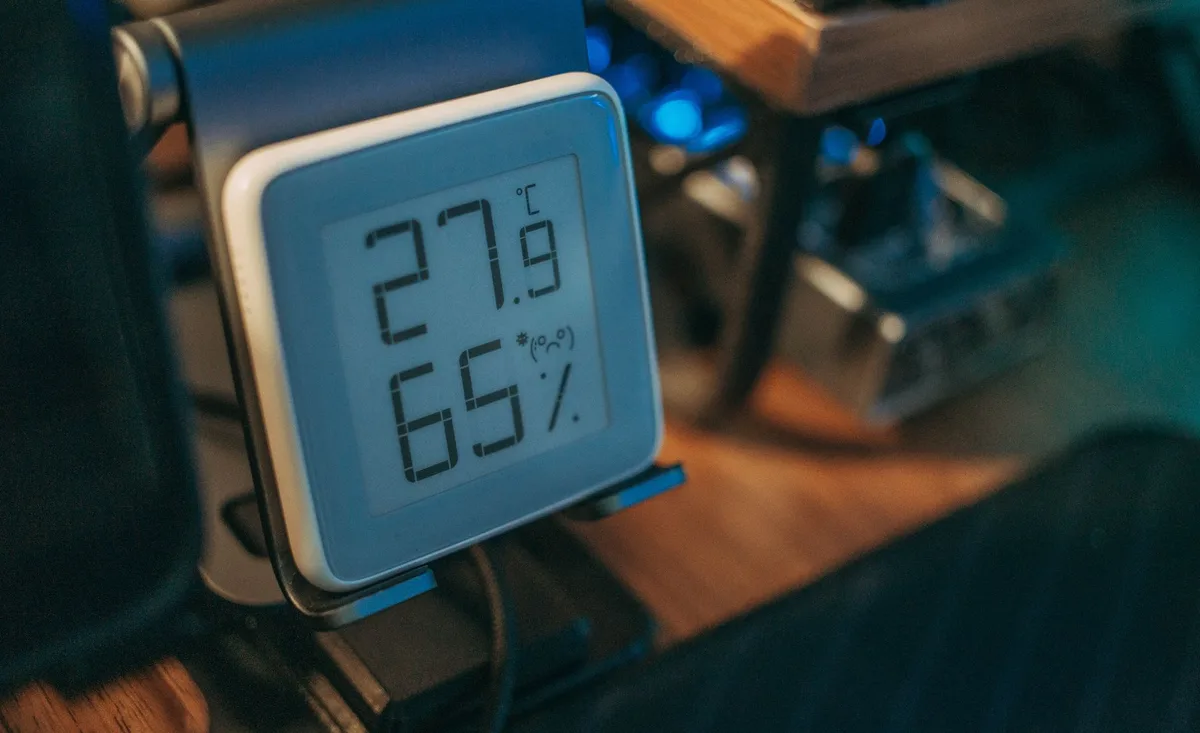
Image source: Pexels / FOX ^.ᆽ.^= ∫ (Pexels License)
If you’re unsure what your humidity levels are, don’t rely on how you feel. Grab a cheap digital hygrometer. Compare the reading to the 30, 50% range and set your machine accordingly.
Does the Temperature Drop When It Runs?
This is a common misconception I want to clear up. We step through the airflow and saw that the air gets chilled, but then it passes over the hot condenser.
In a perfect world, the unit outputs air that is roughly the same temperature as the room, maybe a few degrees warmer. In practice, the air coming out of the top vent is often slightly warm.
Why? Because the compressor runs on electricity, and that electricity generates heat. The motor also generates friction heat.
At the end of the cycle, the dehumidifier actually outputs more heat into the room than it removes. It’s not an air conditioner; it’s a heating machine that just happens to remove water.
So, if you’re running it in a hot garage in August, you’ll feel a slight temperature rise. It’s a minor trade-off for the massive benefit of removing moisture. If you want cooling, you need an air conditioner.
If you want dryness, you need a dehumidifier. They do different jobs, even if they look similar.
The Impact of Airflow and Placement
The mechanics inside the box are solid, but how you use the machine determines its real-world effectiveness.
A dehumidifier only works on the air that passes through it. This sounds obvious, but I see people shove these machines into corners behind furniture all the time. If the air isn’t hitting the intake grill, it isn’t drying.
Here are the golden rules for placement:
- Keep it centralized: Place it in a hallway or an open area where air can circulate freely around it.
- Leave space: You need at least 8, 12 inches of clearance on the intake side and the exhaust side.
- Close the doors: You can’t expect the unit to dry the whole house if you leave the basement door wide open to the humid outdoors. Isolate the space you want to dry.
- Raise it slightly: If possible, place the unit on a table or a concrete block. This helps it pull in the air, which tends to be more humid, and prevents it from sucking in dust and debris off the floor.
Desiccant vs. Compressor: Real-World Performance
When you’re looking at specs, you’ll see them rated in pints per day (P.P.I.). A 50-pint dehumidifier is the standard for a large basement. This rating is based on the amount of water it can pull out of the air in 24 hours under specific standard test conditions.
Here is a quick comparison table to illustrate the kind of power you’re dealing with:
| Feature | Compressor (Refrigerant) | Desiccant |
|---|---|---|
| Best For | Large spaces, warm climates (65°F+) | Small spaces, cold climates (colder than 60°F) |
| How It Works | Cools air to condense moisture | Uses absorbent material to trap moisture |
| Weight | Heavy (20–40 lbs) | Light (10–20 lbs) |
| Energy Use | More efficient in warm weather | Better in cold rooms, but uses more energy overall |
| Output Heat | Adds heat to the room | Adds significant heat to the room |
| Operating Noise | Louder (compressor hum) | Quieter (usually just a fan) |
As you can see, it’s not about which is “better”. It’s about matching the technology to your environment. If you live in the South, go compressor.
If you have a drafty, cold crawl space in the North, the desiccant unit will actually outperform the compressor type because the compressor will struggle to condense water in cold air.
Does the Water Filter Matter? (And Other Maintenance Myths)
One question I get a lot: “Does dehumidifier water need to be filtered?”
The answer is no. The water collected is pure distilled water in a sense. The condensation happens on the coil, and it drips straight down.
It doesn’t run through a filter. However, the air does go through a filter.
Your dehumidifier has an air filter (usually a washable mesh filter) located behind the front grill. This stops dust, dander, and hair from getting sucked into the fan and coating the coils. If this filter gets clogged, the airflow drops, the coil gets too cold, and the machine freezes up.
Pro maintenance tip:Clean that filter every two weeks. Just vacuum it or rinse it in the sink with soapy water. Let it dry completely before putting it back.
This simple habit will double the lifespan of your machine.
You can also attach a garden hose to the drain port and route the water to a floor drain. This is your “set it and forget it” method, no need to empty the bucket ever again.
Is the Water Safe to Drink?
Let’s address the elephant in the room. You look at that bucket of clear water and think, “This looks okay.“
Do not drink it. Dehumidifier water is not safe for drinking.
Why? Because while the water condenses out of the air pure, it sits in a plastic bucket. Airborne contaminants, dust, pollen, mold spores, and potentially harmful bacteria, have already been washed out of the air and they land in that bucket.
The bucket is dark, moist, and has a film of dust for bacteria to feed on. The lack of oxygen inhibitors means algae and mold can grow quite easily.
You can use it for your iron (though it might void the warranty if it leaves particles) or for flushing toilets, but absolutely keep it away from your drinking water. It’s cheap to test, but it’s not potable water. For more details on condensation chemistry, you can look at resources from the National Institute of Standards and Technology for how moisture interacts with surfaces.
Why Dry Air Feels Colder (The Comfort Factor)
There’s a final piece of the puzzle that feels counterintuitive when you first experience it.
You’ve just set up your dehumidifier. It’s running, and the humidity is dropping from 70% down to 45%. Yet, you feel… cold?
Even though we said the machine outputs heat?
That’s your perception playing tricks on you. The heat index is gone. When humidity is at 70%, the air is a blanket of moisture that traps body heat.
At 45% humidity, sweat evaporates off your skin very efficiently. That evaporation process cools you down.
So, a room at 70°F with 70% humidity feels stifling. But a room at 70°F with 40% humidity feels crisp and comfortable, even if the dehumidifier is blowing out slightly warm air. Your skin is the ultimate hygrometer; it senses the drying effect immediately.
The Bottom Line on Dehumidifier Mechanics
We’ve covered a lot of ground, but the takeaway is simple.
A dehumidifier works because of a simple rule of physics: it cools air down to the point where water vapor becomes liquid. It uses a fan to push air over a freezing coil. The coil catches the water. The machine heats the air back up and returns it to you, drier and more comfortable.
Now that you know the internals and the process, you can troubleshoot better, choose the right machine for your climate, and understand exactly what that bucket of water represents.
When you check that bucket and see gallons of water sitting there, you’ll know exactly where it came from. It came from your breathing, your damp clothes, and the air seeping in from outside. And thanks to a clever cycle of compression and condensation, you don’t have to live in it anymore.
That’s the whole story, no magic, just cold metal and physics.


Similar Posts



















[…] How Dehumidifier Works […]
[…] off excess water and let it air‑dry completely, never reinstall a damp […]
[…] residential units use a refrigeration cycle. A fan draws humid air across a cold coil. Water condenses on the coil, drips into a tank or a drain hose, and the dried air passes over a warm coil before returning to […]