How to Organize Shoes in a Small Space
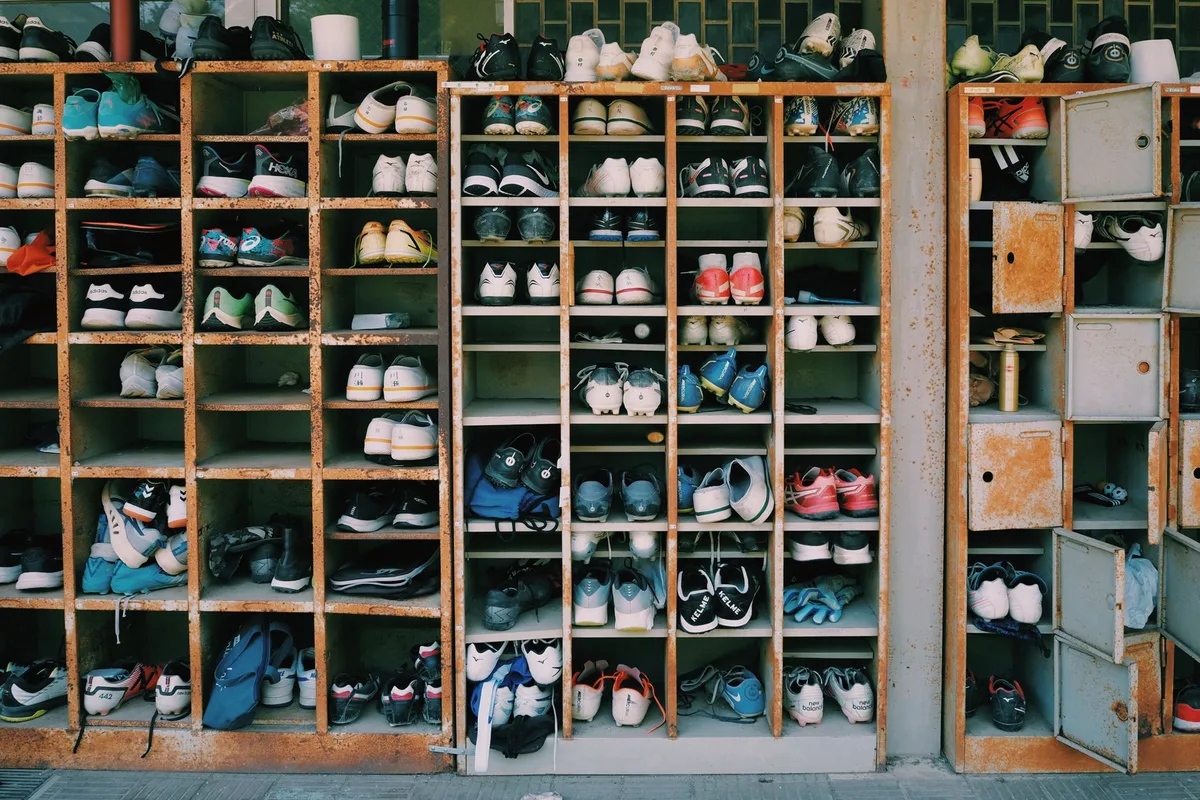
Image source: Pexels / sugar jet (Pexels License)
Let me be real with you. Your shoe collection has grown, but your square footage hasn’t. That tiny apartment entryway, that cramped closet, that narrow hallway, they’re overflowing with sneakers, boots, heels, and flip-flops.
You trip over them every morning. You waste precious minutes hunting for matching pairs. And you’re sick of it.
I’ve helped dozens of friends and clients transform their clutter chaos into organized sanity. The truth is, you don’t need a walk-in closet to store your shoes properly. You just need a system that works within your space.
Not against it.
This guide covers exactly that. I’ll walk you through practical, proven strategies to organize shoes in a small space without sacrificing style or accessibility. No theoretical fluff.
Just real solutions you can implement this weekend.
Why Shoe Storage Falls Apart in Small Spaces
The problem isn’t you. It’s the way most people approach shoe storage in the first place.
We tend to treat shoes like they belong in boxes or on closet floors. But when space is tight, that mindset fails hard. Shoes end up piled by the door, shoved under furniture, or crammed into bins where you can’t see what’s what.
Here’s the core issue: shoes take up unpredictable volume. A pair of flats folds flat. A pair of winter boots takes up four times that space.
A pair of heels needs depth and height. Standard storage solutions treat all shoes the same way, and that never works.
Add in the fact that most small spaces lack dedicated shoe storage zones, and you’ve got a recipe for daily frustration. Your entryway doesn’t have built-in cubbies. Your closet rod sits too low for a traditional shoe rack.
Your under-bed space is already full of other stuff.
So the solution isn’t buying more storage. It’s buying smarter storage that adapts to both your space and your shoe types.
The Core Principles of Small-Space Shoe Organization
Before we dive into specific products and layouts, you need the framework. These four principles guide every decision I make when organizing shoes in tight quarters.
Edit ruthlessly. You cannot organize what you don’t need. Start by pulling out every pair you own. Be honest with yourself.
If you haven’t worn those glittery sandals in two years, donate them. If those running shoes have a hole in the toe, toss them. The goal isn’t to store every shoe you’ve ever owned.
It’s to store the shoes you actually wear.
Think vertical, not horizontal. Floor space is your most valuable asset in a small home. Wall space is underutilized gold. Every shoe you store off the floor frees up square footage for living, not tripping.
Visibility equals usability. If you can’t see your shoes, you won’t wear them. Worse, you’ll forget you own them and buy duplicates. Open storage, clear bins, and organized layouts keep your collection front and center.
Separate by frequency of use. Daily wearers need prime real estate. Seasonal or occasional shoes go to harder-to-reach spots. This isn’t complicated, it’s just matching access to how often you reach for something.
Stick to these four rules, and everything else falls into place.
Step 1: Declutter Your Shoe Collection First
I know you want to jump straight into buying racks and bins. Don’t. That’s how you end up with an organized collection of shoes you still don’t wear.
The three-pile method works best. Create a “keep” pile, a “donate” pile, and a “trash” pile.
For the keep pile, ask yourself these three questions:
- Have I worn these in the last six months?
- Do they still fit comfortably?
- Are they in good enough condition to wear in public?
If you answer no to any of those, that pair belongs in the donate or trash pile. Be brutal. I once helped a client purge 14 pairs of shoes she hadn’t touched in three years.
She didn’t miss a single one.
One exception: special occasion shoes you genuinely wear once a year, formal events, holiday parties, specific dress codes. Those can stay, but they go into the “seasonal” category, not your everyday rotation.
The final pass. Once you’ve sorted everything, count your keep pile. If you own more than 20-30 pairs for a small space, you’re pushing the limits of what you can reasonably store without it feeling cluttered. Think about whether you actually need that many.
Step 2: Measure Your Space and Your Shoes
This step takes five minutes and saves you weeks of frustration.
Measure your available storage areas. Width, depth, and height matter. A standard over-the-door shoe organizer needs about 20 inches of door width. An under-bed bin requires at least 6 inches of clearance.
A wall-mounted rack needs enough wall space between studs.
Measure your tallest shoes. Your tallest pair of boots determines whether a shelf system works. Your widest pair of sneakers determines whether a rack can hold them side by side. Don’t guess.
Measure.
Know your floor plan. Where do you actually take your shoes off? That’s where your daily storage should go. If you kick them off at the front door, the entryway gets priority.
If you change shoes in the bedroom, the closet or under-bed area takes precedence. Don’t fight your natural flow.
Choose the Right Storage Solution
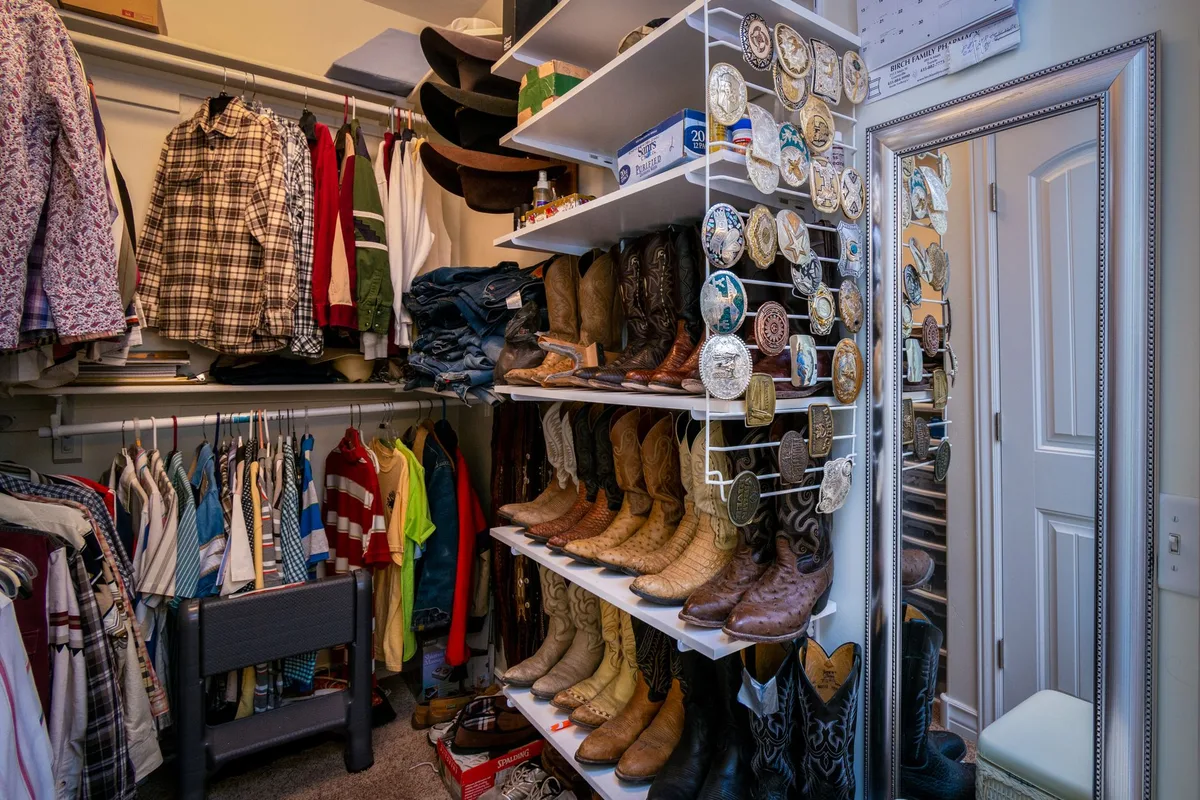
Image source: Pexels / Get Lost Mike (Pexels License)
This is where most people get overwhelmed. There are dozens of products, and none of them are perfect for every situation. So let me break down the best options by type of space.
Over-the-Door Organizers
This is the single most effective solution for small spaces. An over-the-door shoe organizer hangs on the back of any standard door, bedroom door, closet door, even the front door if you have room.
What works: Clear plastic pockets let you see every pair at a glance. Fabric organizers with reinforced pockets hold heavier boots without sagging. Most models hold 12-24 pairs.
What doesn’t: The cheapest fabric ones rip at the hooks within months. Avoid flimsy mesh that stretches out. Pay a little more for heavy-duty stitching.
Best for: Daily wear sneakers, flats, sandals, and low-profile shoes. Not great for tall boots or heavy work boots.
Under-Bed Storage Bins
You probably already have space under your bed. It’s prime real estate that most people waste on random junk.
What works: Low-profile bins with clear lids let you slide them out and see what’s inside. Rolling bins on casters make access easy. Divided bins keep pairs together.
What doesn’t: Bins without lids collect dust. Bins without wheels are annoying to pull out. Fabric bins collapse under weight.
Best for: Seasonal shoes, rarely worn heels, off-season boots. Perfect for storing the pairs you only break out once or twice a year.
Slim Shoe Cabinets
These are narrow cabinets designed specifically for tight entryways and hallways. They’re typically 6-12 inches deep and hold 6-18 pairs.
What works: Tilt-out drawers store shoes on an angle, maximizing depth while keeping the cabinet slim. Closed doors hide the clutter completely. Some double as a bench or coat rack.
What doesn’t: Cheap laminated particle board warps in humid climates. Measure your shoe depth first, some cabinets can’t fit men’s dress shoes.
Best for: Entryways, narrow hallways, mudrooms where you want a clean, furniture-like look.
Wall-Mounted Racks and Shelves
When floor space is zero, look up.
What works: Floating shelves with a lip to prevent shoes sliding off. Wire racks that mount directly to the wall. Pegboard systems with adjustable hooks and shelves.
What doesn’t: Anything that requires drilling into tile or concrete without proper anchors. Overloading shelves rated for lightweight shoes.
Best for: Studio apartments, dorm rooms, any space where every inch of floor is precious.
Stackable Shoe Boxes
These are clear plastic boxes designed to stack vertically. They come in standard sizes that fit most shoes.
What works: Modular design lets you build up, not out. Clear fronts mean you can see everything. Some brands interlock for stability.
What doesn’t: Stacking more than five high becomes unstable without wall anchoring. Some lids crack under weight.
Best for: Closets where you want uniform, dust-free storage with maximum visibility.
Maximize Vertical Space
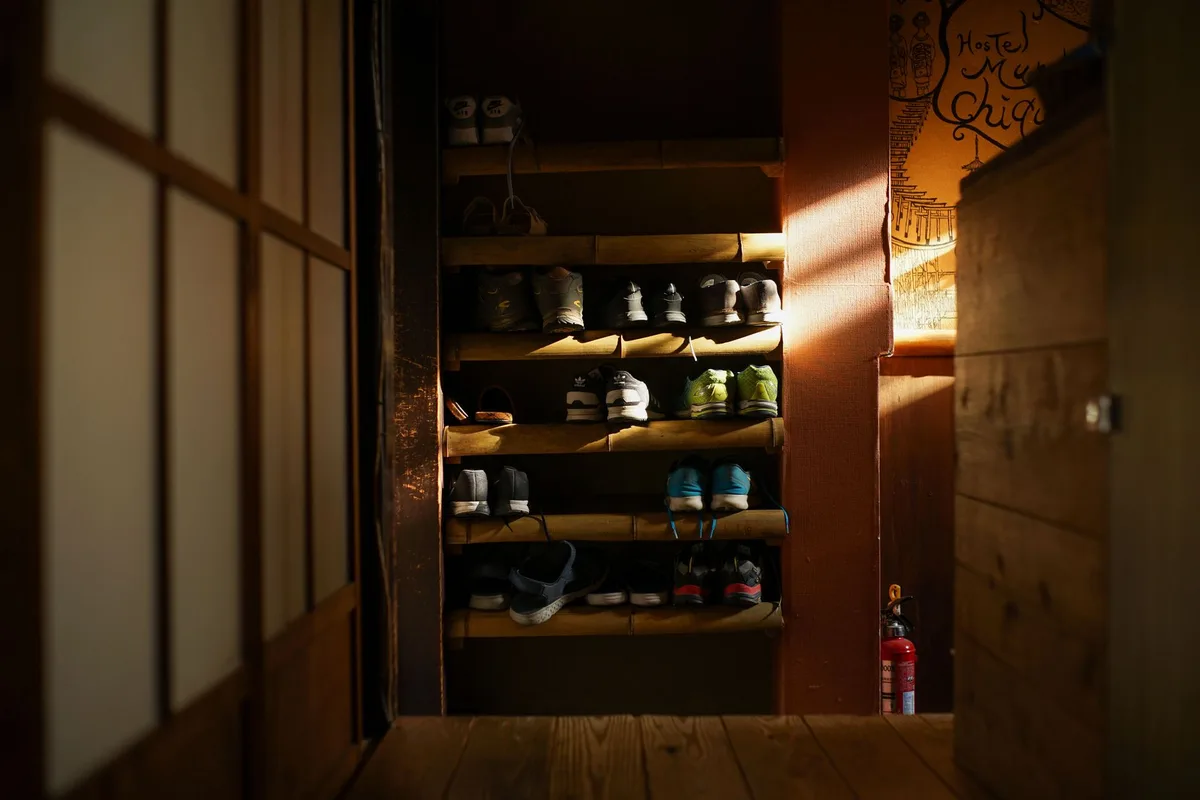
Image source: Pexels / Ngeow Shen Sin (Pexels License)
You’ve heard it before, but I’ll say it again: vertical is your friend. Here’s exactly how to use it.
Use the back of doors. Every door in your home is usable storage. The back of the bedroom door, the bathroom door, even the pantry door. One over-the-door organizer on each door gives you 20+ spots for shoes without taking a single square inch of floor space.
Add floating shelves above existing furniture. Got a dresser, a desk, or a console table? Install a shelf 12-18 inches above it. Store your less frequently worn shoes up there.
It’s out of the way but still accessible.
Install a shoe rack that goes floor to ceiling. Full-height shoe racks exist specifically for this. They have shelves every 6-8 inches and can hold 30-50 pairs in a footprint the size of a small bookcase.
Use the space above your closet rod. Most closets have a gap between the rod and the ceiling. That’s wasted space. Install a second rod higher up, or add a shelf for shoe boxes.
It’s surprising how many pairs you can store up there.
Hang shoes by the heel. Some organizers let you hook shoes by their heel on a horizontal bar. This works great for heels, sandals, loafers, and any shoe with a defined heel. You can fit more pairs per linear foot this way.
Organize by Type and Frequency
Now that you’ve got your storage solutions picked out, it’s time to assign specific homes to specific shoes.
Daily wear zone: This is the most accessible spot. Over-the-door organizer at eye level. Top row of a shoe cabinet.
The shelf you reach without bending. Only put shoes here that you wear at least once a week.
Occasional wear zone: Second tier of accessibility. Middle shelves of a cabinet. Under-bed bins you can slide out in five seconds.
These are for date-night shoes, gym shoes, weekend boots.
Seasonal zone: Hardest to reach. Top shelves near the ceiling. Under-bed bins in the farthest corner.
The back of a closet behind everything else. These are winter boots in summer, sandals in winter, formal shoes you wear twice a year.
Keep pairs together. This sounds obvious, but you’d be surprised how many people store left and right shoes separately. Always store them as a pair. If one shoe faces forward and one backward, it’s easier to grab both at once.
Rotate seasonally. Twice a year, swap your seasonal and daily zones. When spring hits, move boots to the seasonal zone and sandals to the daily zone. This keeps your most-used shoes always in the easiest spot.
Small Space Hacks That Actually Work
These aren’t gimmicks. They’re real techniques I’ve used in actual small apartments.
Use the space under your entryway bench. If you have a bench, it probably has legs. That gap underneath is perfect for a low-profile shoe tray. Slide shoes in front to back, not side to side, to fit more pairs.
Turn a bookshelf into a shoe cabinet. An IKEA Billy bookcase holds 12-15 pairs per shelf if you stand shoes upright. Add a tension rod across the front to keep them from falling out. Paint it to match your room.
Instant custom storage for under $50.
Hang a shoe bag on the back of the bedroom door. One of those clear pocket organizers meant for bathroom toiletries works perfectly for flats and sandals. It’s cheap, it’s discreet, and it takes zero floor space.
Use command hooks for individual pairs. Two command hooks side by side hold a pair of flip-flops. A single heavy-duty hook holds a pair of heels by the straps. This works on walls, inside closet doors, and even on the side of furniture.
Keep a boot shaper in tall boots. Boots that collapse into themselves take up less space and stay in shape. A simple rolled-up towel works. It keeps your boots upright and prevents them from slouching into each other.
Go vertical with pegboard. A cheap pegboard panel mounted on the wall gives you infinite configuration possibilities. Add hooks for heels, shelves for sneakers, baskets for sandals. You can rearrange it in minutes as your collection changes.
Maintaining Your System Long-Term
You’ve done the work. Your shoes are organized, visible, and accessible. Now keep it that way.
The one-in-one-out rule. Every time you buy a new pair of shoes, donate or toss an old pair. Your collection stays the same size forever. No growth, no clutter creep.
Weekly reset. Every Sunday, spend two minutes putting shoes back where they belong. It’s easier than dealing with a pile that takes an hour to sort.
Monthly audit. Once a month, scan your collection. Are there shoes you haven’t worn? Does a pair need repair?
Address it before it becomes a problem.
Annual deep edit. Every year, go through the same three-pile process. Your taste changes. Your lifestyle changes.
Your shoes should reflect that.
Don’t buy storage before you need it. Resist the urge to “future-proof” by buying larger organizers. Buy storage for the shoes you currently own. As your collection changes, adjust your storage.
This prevents wasted space and unnecessary purchases.
Common Mistakes to Avoid
I’ve seen these mistakes hundreds of times. They’re easy to make and hard to undo.
Buying storage without measuring. The most expensive shoe rack in the world is useless if it doesn’t fit your space or your shoes. Measure twice. Buy once.
Storing shoes in original boxes. You can’t see what’s inside. You’ll end up opening five boxes to find the pair you want. Use clear bins or ditch the boxes entirely.
Overcrowding shelves. Squeezing shoes into too-small spaces damages them. Leather creases. Heels scuff.
Let your shoes breathe.
Forgetting about accessibility. If you can’t reach a pair without moving three other pairs, you’ll stop wearing those shoes. Make everything easy to grab.
Ignoring climate control. Extreme heat and humidity damage shoes. Attics and garages are terrible storage spots. Keep your shoes in a climate-controlled part of your home.
Final Thoughts
Organizing shoes in a small space isn’t about having less. It’s about having smart systems that make your collection work for your lifestyle, not against it.
Start with the edit. Measure your space. Pick the right storage for your shoe types.
Go vertical. Rotate seasonally. And stick with the maintenance habits.
Your morning routine will thank you. No more hunting for a matching pair. No more tripping over a pile by the door.
No more buying duplicates because you forgot you already owned those sneakers.
Take this weekend to do it. You’ll wonder why you waited so long.


Similar Posts